
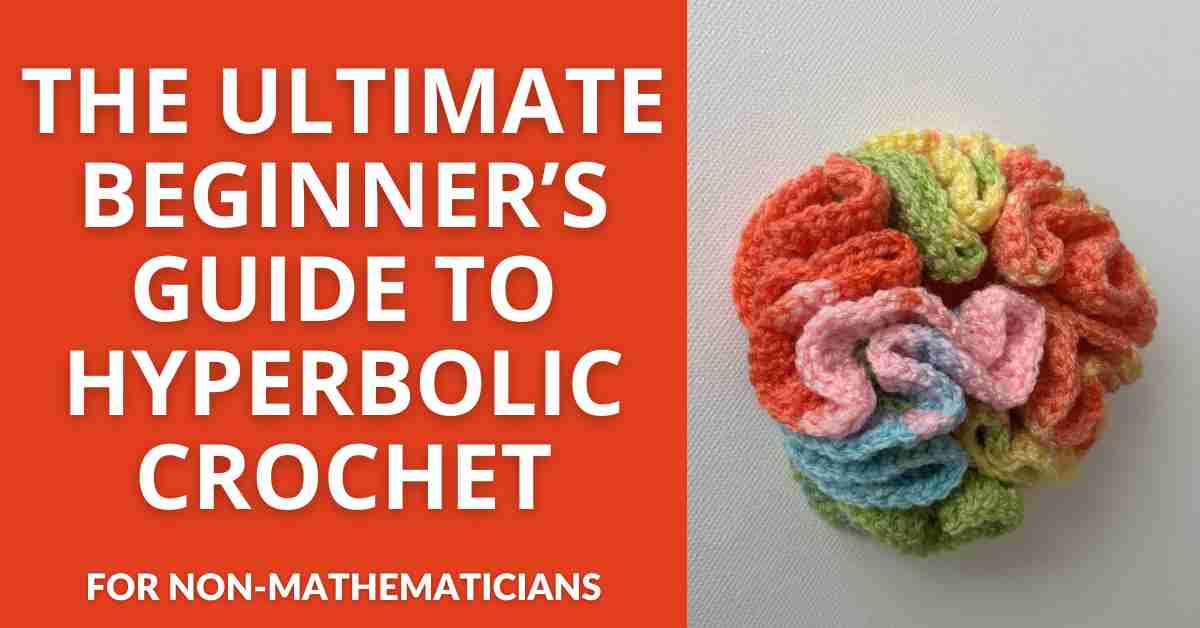
The Ultimate Beginner’s Guide to Hyperbolic Crochet
The Science of the Scrunched
We all know that the art of crochet has LOTS to do with mathematics. We're always instructed to "count our stitches" and have the correct number of multiples, increases or decreases to get our projects to look exactly like the patterns suggest.
When I started designing my own patterns, I had to concentrate even more on mathematical calculations. I had to count and recount my stitches over and over again to make sure I got the correct gauge and sizing, and had to make triple sure I wrote down the figures on the instructions correctly so as not to be called out for having made a mistake in my pattern (God forbid!)
Crochet & Mathematics
I first read about "Hyperbolic Crochet" when I was designing my Worry Worm series. I was researching how to crochet various curls and even experimented with these corkscrew spirals a little bit, seeing how the curls fall differently depending on how many stitches one crammed into each stitch from the previous row.
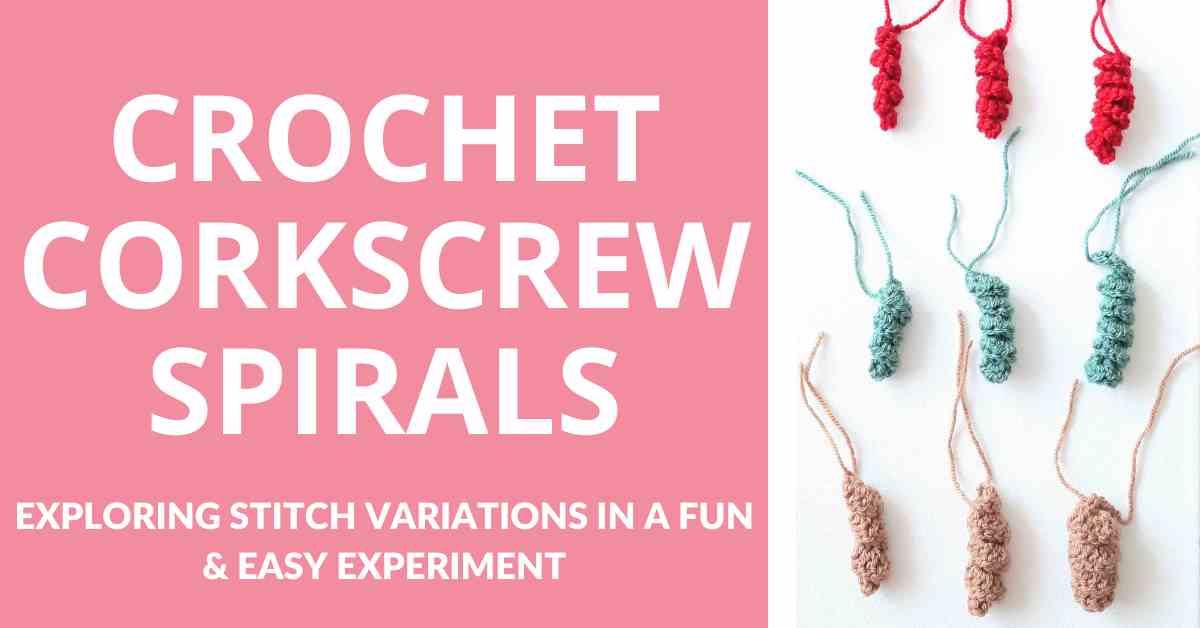
But other than spirals, turns out one can make incredibly beautiful organic-looking shapes with Hyperbolic Crochet: think waves and ruffles found in things like lettuce leaves, flowers, sea slugs, corals, horse saddles or even brains! These are all surfaces with constant negative curvature (more on that below).
The more I researched Hyperbolic Crochet, the more interested I became! How fascinating that CROCHET IS THE ONLY WAY one can reproduce the hyperbolic form! What? I know that crochet is fabulous, and we all love it to bits, but this is just beyond interesting!
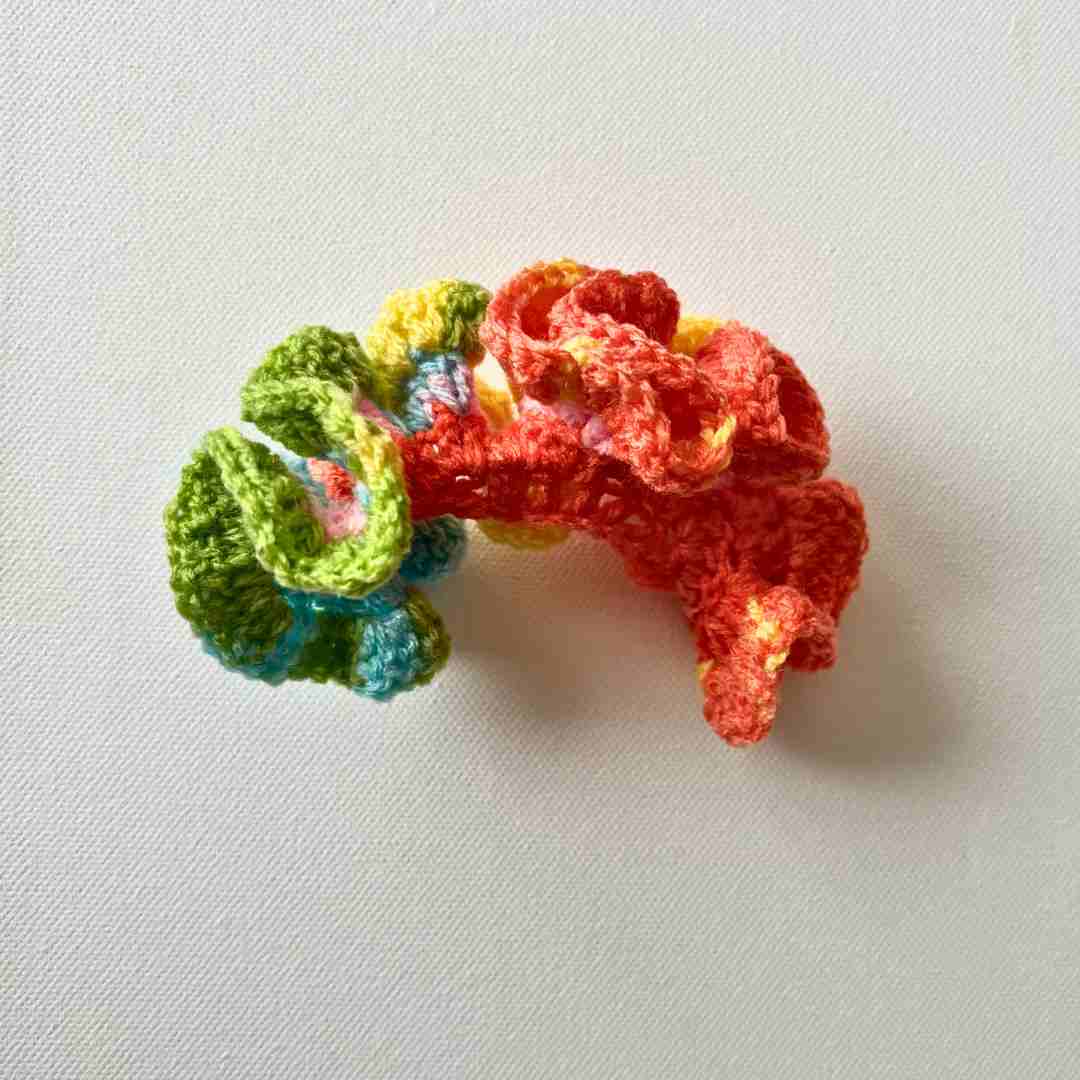
A hyperbolic plane crocheted in rows
Like this guide? Save it to Pinterest for later!
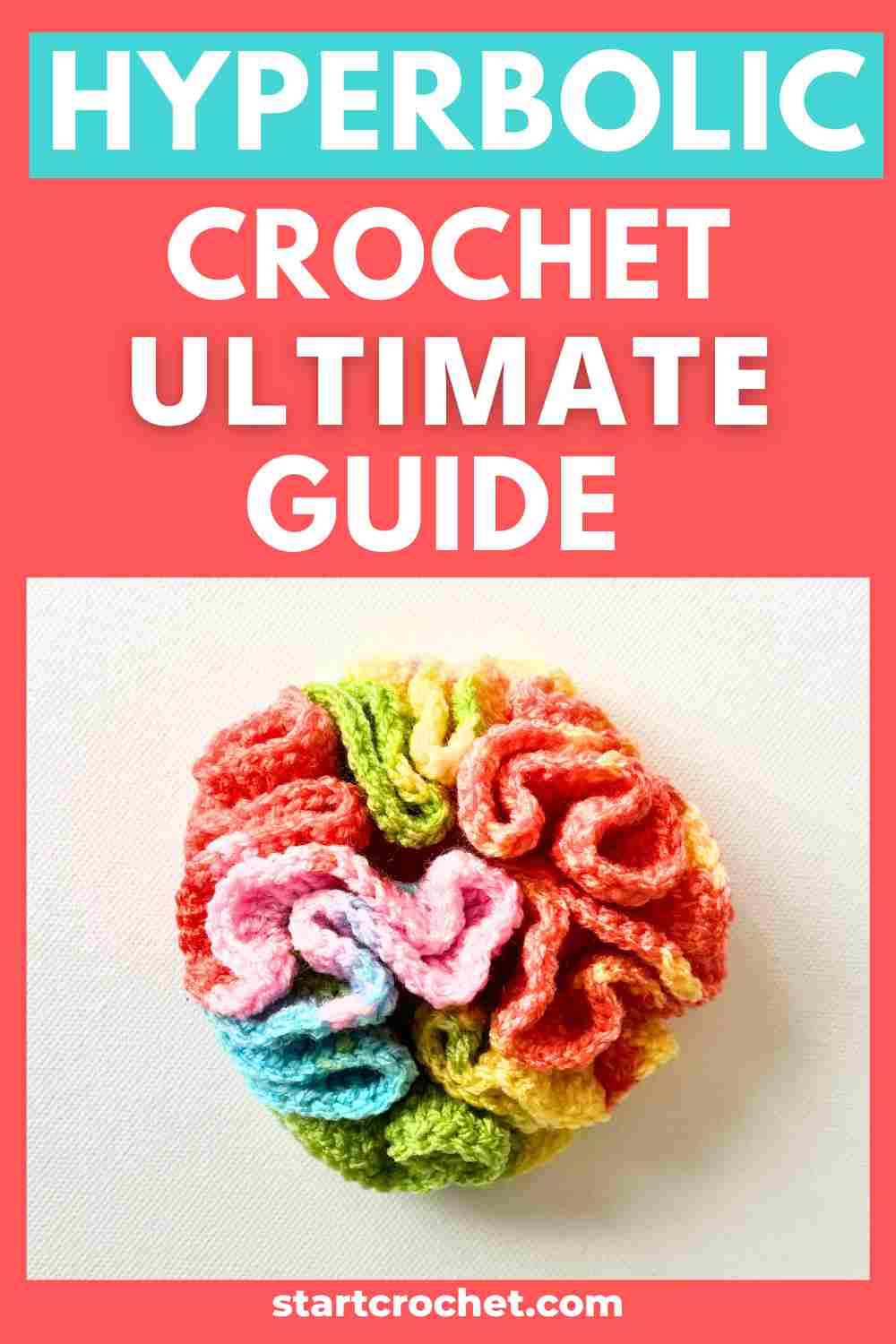
The Historic Backgorund of Geometric Shapes
Flat, Bulged or Ruffled?
Imagine you draw a straight line on a flat piece of paper. Now, pick a point anywhere else on that page. For over 2,000 years, the world followed a rule by the Greek mathematician Euclid. He claimed there is exactly one straight line you can draw through that point that will stay perfectly parallel to your first line. Like train tracks on a flat plain, they will never, ever touch.
But in the 1800s, mathematicians realized this "common sense" only works if the world is perfectly flat. Once the ground starts to curve, the rules of "straight" lines break in two opposite ways:
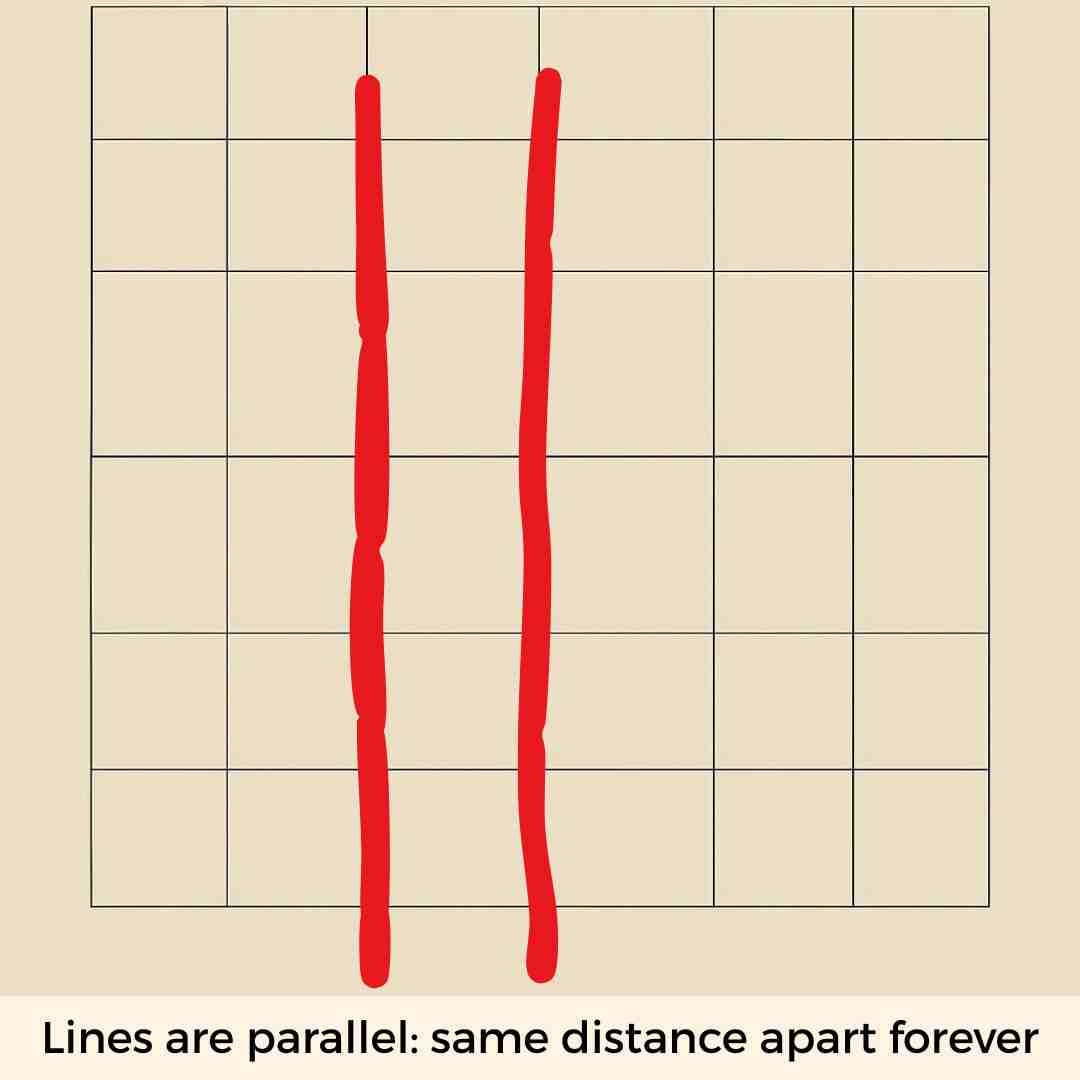
Flat (Euclidean Surface)
On a Sphere (The Beach Ball): If you draw a "straight" line on a ball and pick a point next to it, zero parallel lines exist. Because the surface curves inward, any "straight" path you take will eventually wrap around and crash into your first line (just like how all lines of longitude meet at the North Pole).
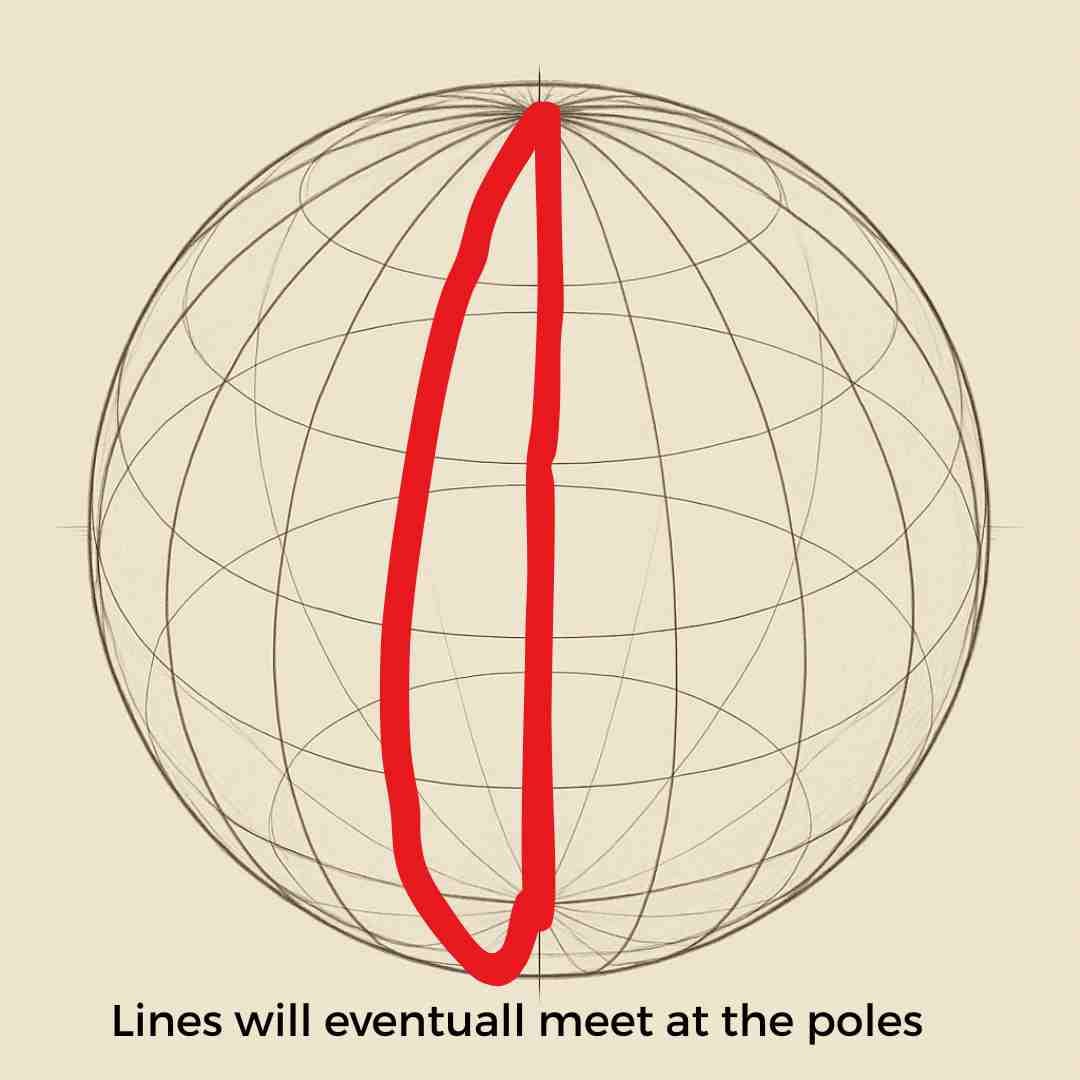
Lines on a Sphere (Ball)
On a Hyperbolic Plane (The Kale Leaf): This is where crochet comes in! Because the surface is ruffling and expanding outward, there is "extra" room. If you pick a point next to your line, you can actually draw infinitely many straight lines through it that will never touch your original line. They all just fan out and diverge into the ruffles.
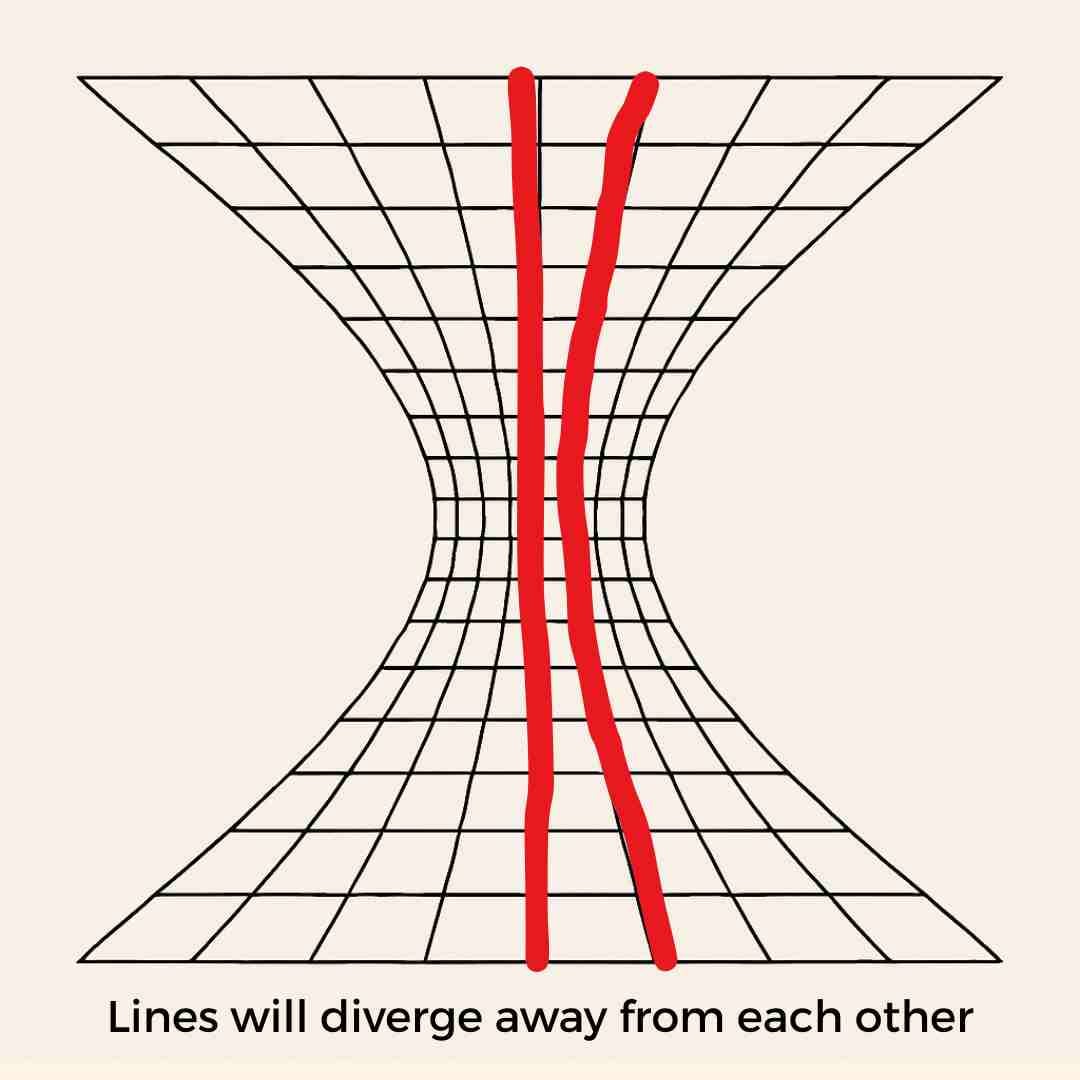
Lines on a hyperbolic plane
This discovery proved that "straight" is relative. Whether you are decreasing stitches to close a sphere or increasing them to grow a hyperbolic ruffle, you are literally changing the laws of geometry with your hook!
Who Discovered Hyperbolic Crochet?
There is actually a bit of a "time jump" between the math and the yarn (crochet)!
The Math (18th & 19th Century)
While mathematicians like Johann Heinrich Lambert (1700s) and later Janos Bolyai and Nikolai Lobachevsky (early 1800s) "discovered" the existence of this geometry, they actually had a hard time visualizing it. For over 100 years, most professors told their students that these shapes were "impossible to build or see in the physical world".
The Crochet (1997)
Hyperbolic crochet wasn't actually discovered until 1997. It was invented by the Latvian Mathematician Dr. Daina Taimina, at Cornell University. She's the one who discovered how to replicate the Hyperbolic shape through crochet.

Dr. Daina Taimina (Hyperbolic Crochet)
In her lectures on Hyperbolic Geometry at Cornell University, she decided to use crocheted fabrics to demonstrate hyperbolic planes, rather than the conventional use of cut up papers that were taped together.
Crochet provided a much more durable and visual way to show the straight lines on the curved surfaces. If you hold up a crocheted hyperbolic piece, you can do the "folding trick". This is when you fold the crocheted piece at any point, and can clearly see that the crease is a perfect straight line on that curved surface.
In the Forward to Dr. Taimina's book, Crocheting Adventures with Hyperbolic Planes (2009), mathematician William Thurston, the designer of the paper model of hyperbolic planes, called Taimiņa's models "deceptively interesting". He was intrigued at how these crocheted models "make possible a tactile, non-symbolic, cognitively holistic way of understanding the highly abstract and complex part of mathematics non-euclidean geometry, is." (Taimina, Daina (2009). Crocheting Adventures with Hyperbolic Planes. CRC Press, Taylor & Francis Group, an A K Peters book.
Why did it take so long?
Before Dr. Taimina, mathematicians tried to make models out of paper and tape, but they were fragile and didn't fold correctly. She realized that the "constant increase" of crochet stitches was the exact physical manifestation of the math these men had been struggling to visualize for centuries. She literally "hooked" the math into reality!
While the geometry is hundreds of years old, the crochet models are a relatively modern "Aha!" moment that finally allowed people to hold this complex math in their hands.
So what is Hyperbolic Crochet exactly?
Hyperbolic Crochet is when you increase your crochet stitches at a constant rate. By doing this, you force the fabric to curve and fold in on itself, which makes it grow exponentially faster than a flat surface would normally accommodate.

Rows crocheted in double crochet increases in each stitch across
"In hyperbolic geometry there is more material as you move away from the centre. A piece of hyperbolic geometry maximises surface area while minimising volume, which is perfect for leaves which want a large surface area to capture the most sunlight, or a coral reef which wants to collect the most nutrients. This is why, in hyperbolic crochet, we keep adding in more stitches, and why it looks very organic." (Maths Craft Australia, How To Crochet a Hyperbolic Plane).
Understanding Curvature Without the Math

The 3 types of curves in crochet: Flat, Sphere, and Hyperbolic
Euclidean is like a Flat Circle: If you lay it on a table, it stays perfectly flat. If you want to grow the size, you just add more rounds to the edges at a steady, predictable rate. Here's the exact rate at which you'd increase the size of a FLAT circle. For more details on this, have a look at this post on how to crochet a flat circle.
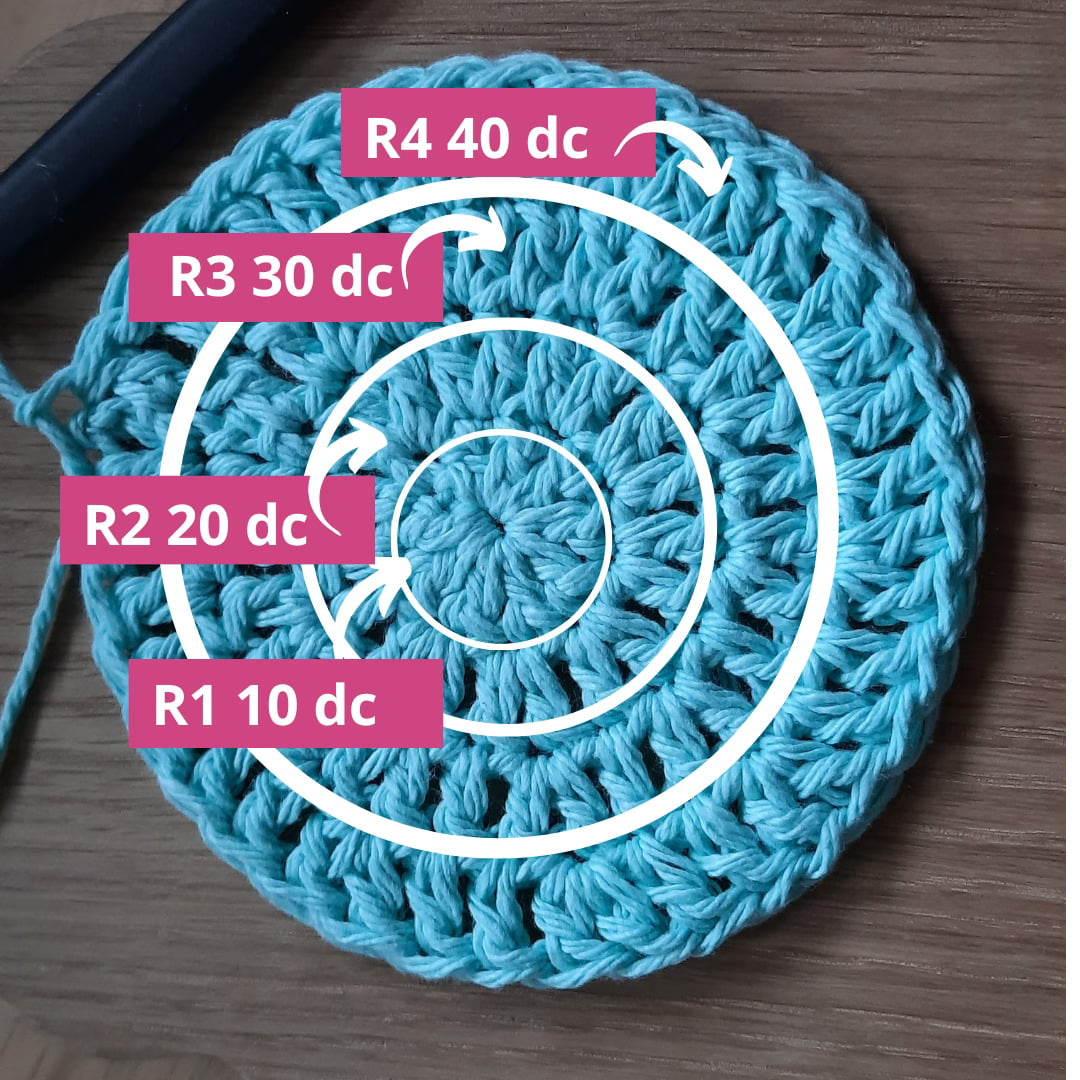
How to crochet a flat circle in Double Crochet
Spherical is like a Beach Ball: To wrap a flat piece of paper around a ball, you have to fold it or "pinch" it (these are like decreases in crochet). The surface is "closed" and eventually runs out of room, meeting back at the top.

A crocheted ball (Sphere)
Hyperbolic is like a Head of Kale: There is "too much" surface area for the space it occupies. Because you are constantly increasing your stitches, the edge of your crochet is growing much faster than the center. Since it can't stay flat, it has no choice but to fold, ruffle, and wave in all directions to fit all that extra material.

A crocheted hyperbolic plane (top view)

A crocheted hyperbolic plane (bottom view)
Let's compare hyperbolic crochet to the normal Eucledian or Spherical shapes. An example of a Eucledian crochet project would be a flat circle or granny square, for instance, and a spherical project could be a round ball or amigurumi figure.
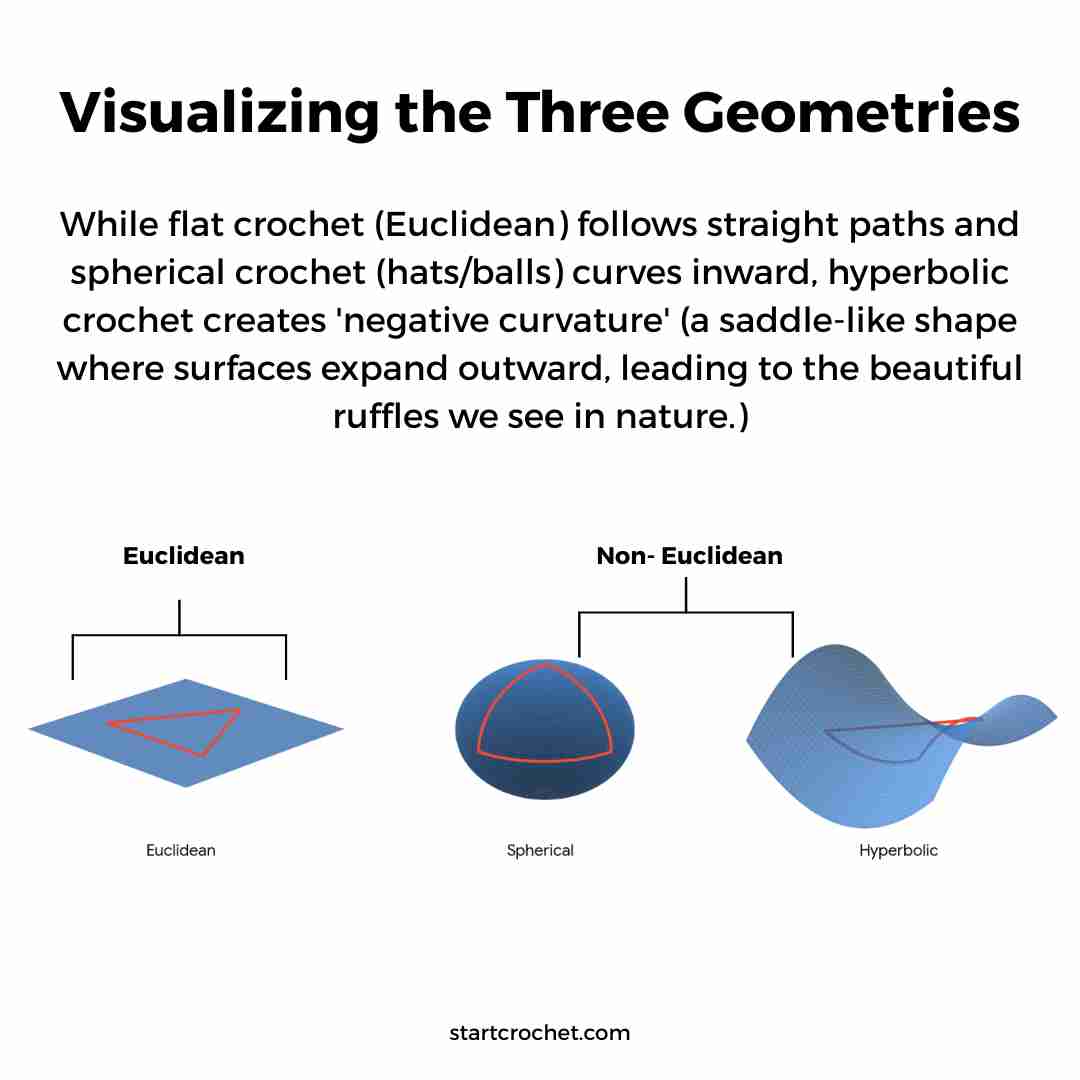
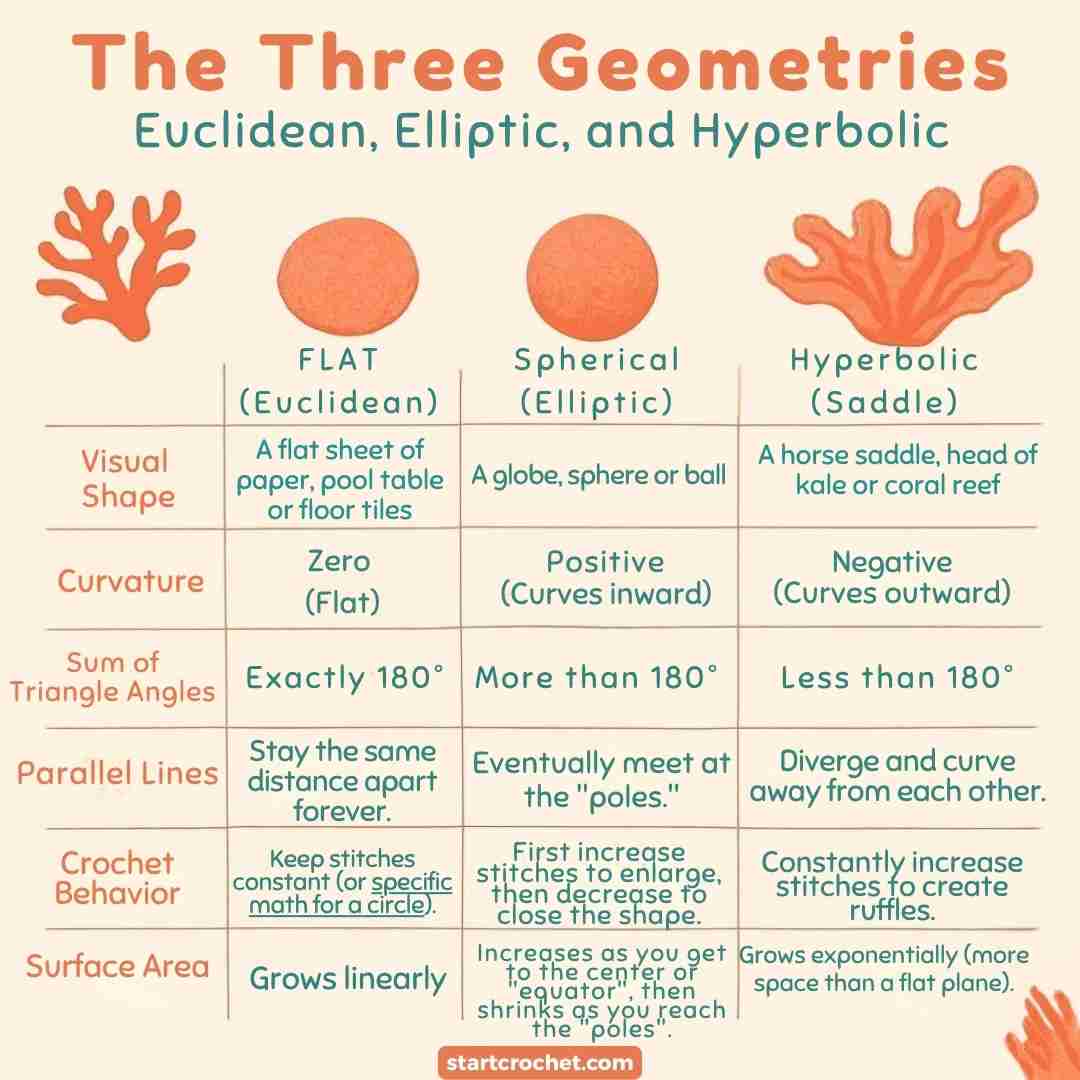
Have a look at the similarities and differences of the 3 types of Geometric planes side by side:
| Feature | Euclidean (Flat) | Spherical (Elliptic) | Hyperbolic (Saddle) |
|---|---|---|---|
| Visual Shape | A flat sheet of paper. | A globe or ball. | A head of kale or coral reef. |
| Curvature | Zero (Flat). | Positive (Curves inward). | Negative (Curves outward). |
| Sum of Triangle Angles | Exactly 180°. | More than 180°. | Less than 180°. |
| Parallel Lines | Stay the same distance apart forever. | Eventually meet at the "poles." | Diverge and curve away from each other. |
| Crochet Behavior | Keep stitches constant (or specific math for a circle). | First increase stitches to enlarge, then decrease to close the shape. | Constantly increase stitches to create ruffles. |
| Surface Area | Grows linearly. | Increases as you get to the center or "equator", then shrinks as you reach the "poles". | Grows exponentially (more space than a flat plane). |
Nature loves Hyperbolic geometry because it’s the most efficient way to pack a lot of "surface area" into a small space, which is why lettuce, coral reefs, and sea slugs all look like hyperbolic crochet!
This is truly a rare bridge between high-level mathematics (non-Euclidean geometry) and tactile art.
What Skills Are Needed to Crochet A Hyperbolic Plane?
I'm sure you'll be happy to hear that you don't need to be an advanced crocheter to be able to crochet a hyperbolic plane. If you know how to work up a chain and single crochet stitch, you're good to go. Here are my photo and video tutorials for complete beginners:
How to Crochet the Slip Knot, Chain Stitch and Single Crochet Stitches.
What Tools Do I Need to Crochet a Hyperbolic Shape?
To be able to work up a hyperbolic shape, you'll need some yarn and a crochet hook. That's it! Best would be a sturdy non-stretch medium weight yarn in cotton or acrylic and a hook that's slightly smaller than what's recommended on your yarn's label. That's to make sure that your stitches are nice and tight.
You could, of course, use any other materials you have lying around. Why not recycle some unused plastic bags (cut into strips) or tape from old cassette tapes that no one listens to anymore?
What Techniques Do I Need to Crochet a Hyperbolic Shape?
The Fundamental Technique is to have "Constant Increases".
Unlike a flat circle (where you increase a specific number of stitches per round), hyperbolic crochet increases at a ratio.
A flat crochet circle in Double Crochet
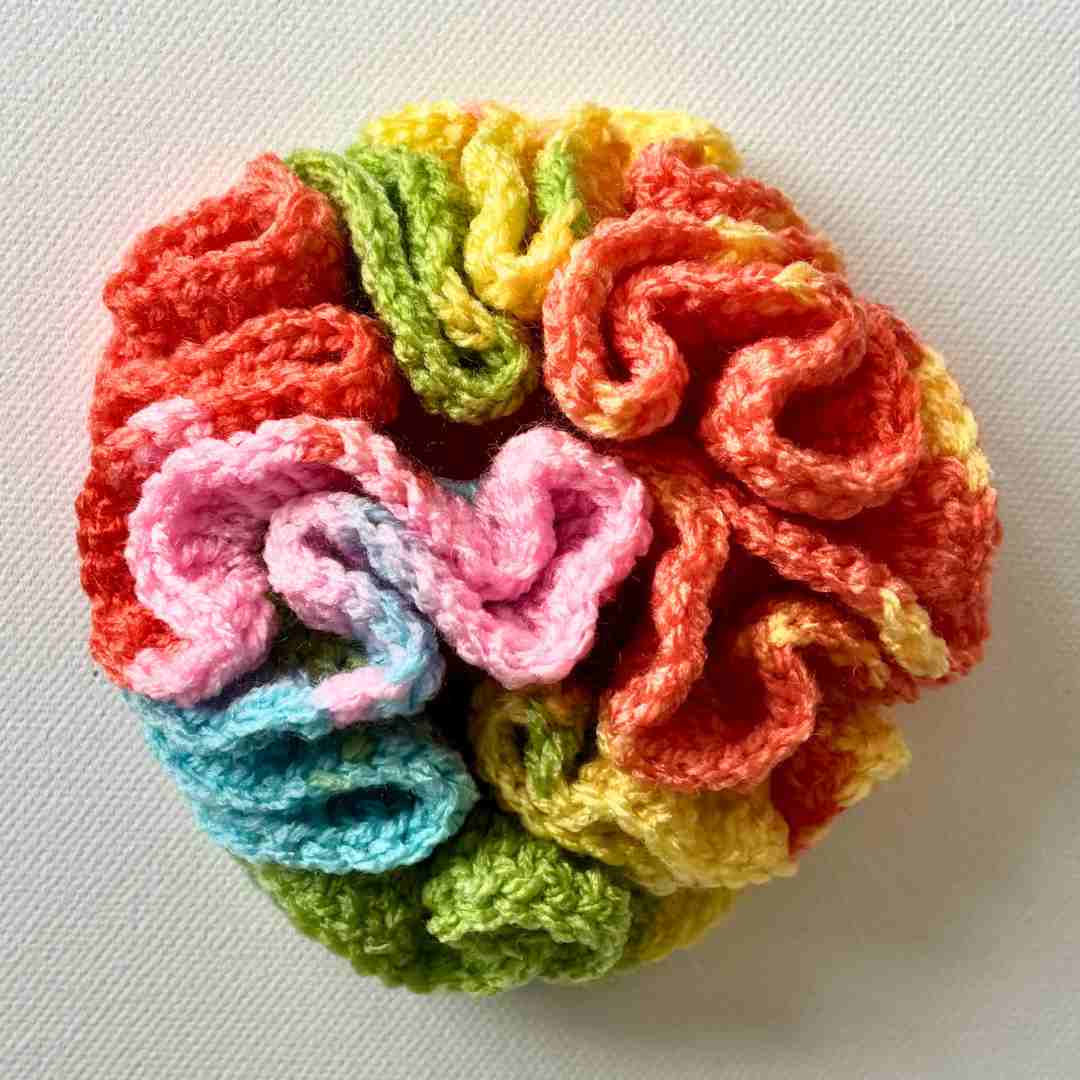
A hyperbolic crochet circle in Double Crochet (ratio 1:2) Each round has double the number of stitches from previous round.
You don't have to double each stitch, you could follow the simple hyperbolic formula:
x = n + 1 where you have 1 increase in every "n" stitches (like increasing in every 3rd stitch) creates a predictable, mathematically perfect ruffle.
This works for both rows (crocheting back and forth in a line) or for rounds (crocheting in a circle).
Visualizing Growth Rates (The "Curly-ness" Scale)
- Low Growth (Increase every 5th or 6th stitch): Results in gentle waves, similar to kale or lettuce leaves.
- Medium Growth (Increase every 2nd or 3rd stitch): Creates deep ruffles, perfect for sea slugs or anemones.
- High Growth (Increase in every stitch): Results in an extremely dense, tight "brain" coral effect that folds immediately (like the photo above).
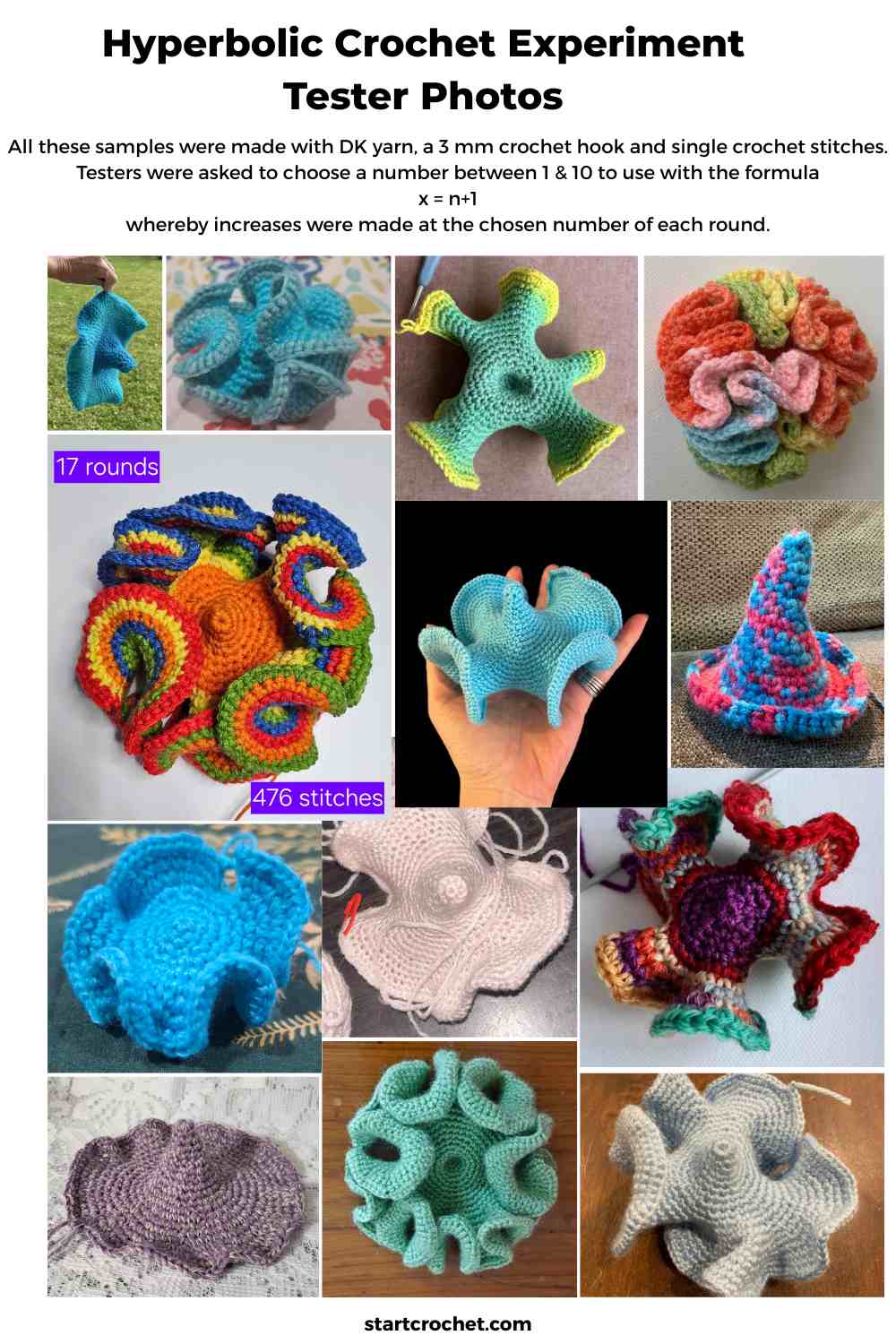
Thank you to all my testers: Niccy McOrrie, Barbara Happee, Amanda Reynolds, Vanessa Riehm, Beatrice Grita, Amrit Paul, Regina Lee, Emily Marie, RosemaryAJ
Troubleshooting & Beginner Tips
- Don't Panic at the "Squish": The fabric will naturally start to fight for space; this is the geometry working correctly.
- Maintaining Consistency: If you start increasing every 3rd stitch, you must continue that exact pattern for the entire piece to maintain the hyperbolic plane.
- Managing Your Yarn: These pieces "eat" yarn exponentially, the last row may have more stitches than the rest of the project combined.
Updates & Patterns
Would you like more Hyperbolic Crochet updates and patterns sent straight to your inbox? If so, please sign up below.
What Projects Could I Make Using the Hyperbolic Crochet Technique?
There are lots of project you can make using Hyperbolic Crochet. I have some easy projects here on my blog if you'd like to give them a go:
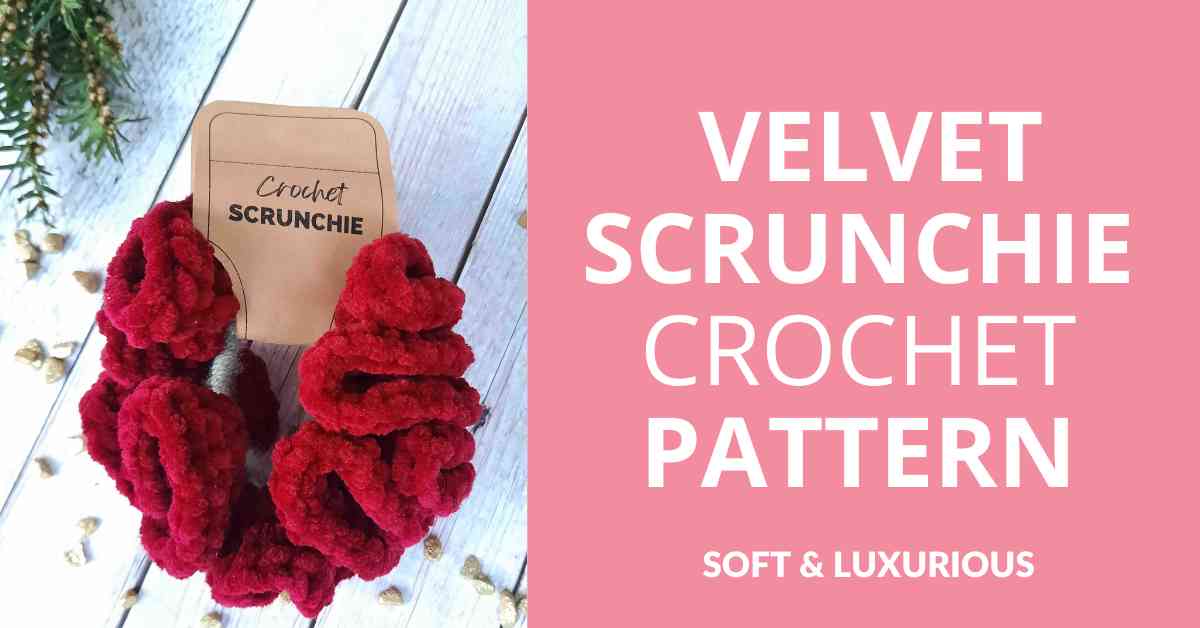
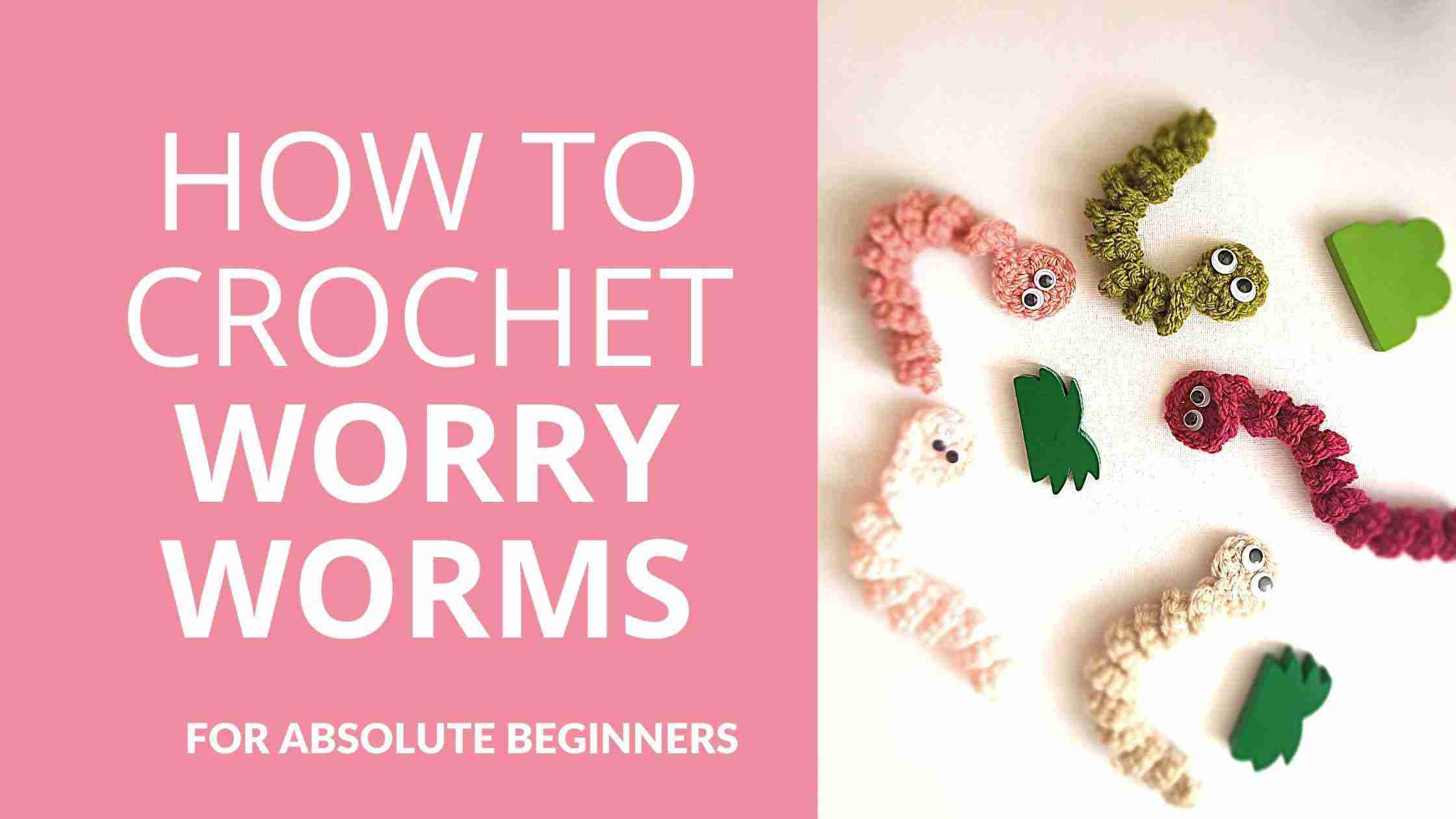
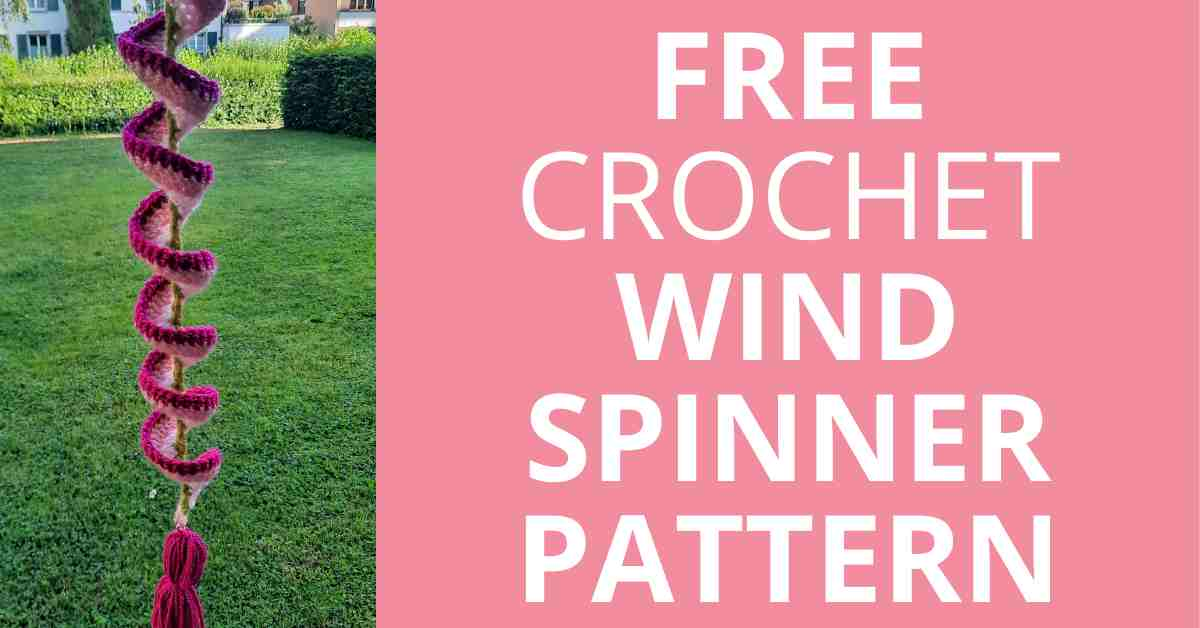
I hope you enjoyed this tutorial on hyperbolic crochet! If you have any observations, questions or you feel I should clarify anything in this article, please let me know in the comments below.
Happy hooking!
May
Let's Keep in Touch :)
You May Also Like

About the Author
May
Follow me on socials here: